

Components used in military and defense applications must endure some of the toughest environments. From arctic temperatures to desert heat, reliability is non-negotiable. Every part must be engineered and manufactured to deliver consistent performance under pressure, ensuring mission success when it matters most.
Helical Springs play a pivotal role and are an excellent example of components that are exposed to the most extreme operational and environmental conditions. These springs are widely used in defense-grade equipment and safety mechanisms for tension control and supplying force. Defense systems operate under uncompromising standards, where every component must meet stringent MIL-SPEC requirements. This means not just any helical spring will do. Manufacturers and defense contractors select suppliers capable of engineering and producing springs in full compliance with military specifications.
At John Evans’ Sons, we have proudly served the defense industry successfully for decades. As far back as World War I, we were the first U.S.-based springmakers producing precision springs and mechanical components for early aircraft oxygen systems and tank field assemblies.
Today, that same commitment to precision guides the production of compression springs for advanced defense technologies. The sections below detail how helical springs function within defense applications and the stringent specifications they must meet.
How Different Helical Spring Types Support Defense Performance
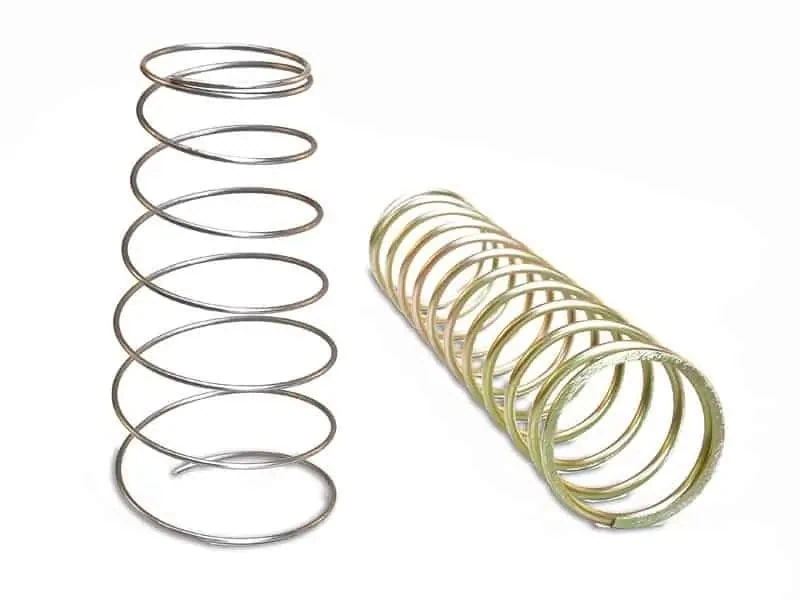
Helical springs can be manufactured from different metals, in a range of types and sizes, and with wire of different thicknesses. They can be further optimized for an application by adjusting spring diameter, and pitching links to create desired force and minimize metal fatigue.
Common types of springs used in defense applications are:
- Compression springs: Compression springs absorb shock and are often used to actuate latches and safety mechanisms, or for vehicle suspension support.
- Extension springs: These apply precise tension hatch returns and mechanical latching in many applications from sensors to heavy equipment.
- Torsion springs: These are used in high-torque rotational applications, including armored hatch counterbalance mechanisms, deployable doors, and UAV mechanisms.
Defense Sector Applications
Since they can be modified with great precision, helical springs are used in many different types of equipment, structures, and vehicles. From tiny springs used to enhance precision in flight controls to torsion springs used for counterbalancing heavy cargo doors, helical springs play many roles in the defense sector.
Ground Vehicles & Military Transport
Helical springs are used in military vehicles to perform critical functions and ensure crew safety. For example, our torsion springs counterbalance heavy hatch covers and cargo doors on M1A1 Abrams Tanks and Bradley Fighting Vehicles. Compression springs assist with load management in suspension and seating in various vehicles.
Aircraft & UAV Systems
Helical springs from John Evans’ are used in aircraft and unmanned drones in many ways. Extension springs and torsion springs are used in various parts of flight controls, landing gear deployment, and precision UAV launch and recovery equipment.
Naval & Marine Defense Systems
Designed for harsh environments, helical springs are often used in marine and naval applications. For example, our helical springs help suspend and secure deck equipment and stabilization systems in harsh marine conditions. We also provide corrosion-resistant springs that are used in many types of shipboard and offshore machinery.
Fuel & Refueling Systems
Fueling systems that transfer fuel from one military aircraft to another while in flight require precision equipment and controls to avoid disasters. We manufacture compression springs that help regulate boom arm pressure and fuel pump actuation for functionality and safety.
Communications & Electronics
Small coil springs manufactured by John Evans’ Sons are used throughout communications and electronic systems in military vehicles and aircraft. Springs maintain connector contacts, secure shields on sensitive avionics, and protect electronics from shock. Springs dampen vibrations in mobile command gear and radar mounts.
Materials and Design Requirements
Helical springs can be made of music wire, oil-tempered and stainless steel, and numerous alternate alloy metals. Stainless steel is often used in the defense industry for its strength, reliability, and high temperature resistance. Inconel is a superalloy that can withstand temperatures three times higher than higher-grade steels, making it ideal for jet engines and nuclear power plants.
The choice of spring materials depends on the specifications of the application, including properties such as low metal fatigue, corrosion resistance, and temperature tolerance. Parts are often required to meet MIL-SPEC standards, which may restrict the metal types and finishes used. Many types of springs used in the defense and military sectors require custom modifications or end treatments for reliable spring behavior. Building a relationship with a trusted spring manufacturer with defense experience is key to an ongoing supply of these specialized springs.
Performance Under Extreme Conditions
Equipment used in military environments will be subjected to a range of extreme conditions, and must still perform correctly and reliably. Military-grade helical springs must be designed to withstand these hazards:
- Extreme and fluctuating temperatures: Military vehicles, equipment, and aircraft are exposed to sub-zero temperatures in arctic winters and extreme heat in working jet engines and desert environments.
- Corrosion and environmental stress: Naval and desert operations expose springs to salt, fog, humidity, dust, and fungal exposure.
- Shock and vibration durability: Springs undergo MIL-SPEC cyclic testing, salt-fog chambers, and vibration tables to ensure viability when exposed to blast loads, artillery recoil, and aircraft vibrations.
- Fatigue resistance and longevity: Helical springs are designed and validated to survive millions of cycles with consistent structural integrity for the expected life cycle of equipment like landing gear or hatch mechanisms.
John Evans’ Sons: A Legacy of Defense Spring Expertise
Helical springs are an often unseen, yet indispensable way to ensure safety, performance, and mission readiness in defense equipment and tasks. John Evans’ Sons has a long history of providing high-quality spring components that meet military and defense application requirements.
From precision straps for aircraft oxygen systems during WWI and evolving applications throughout WWII, to uses in modern conflicts, John Evans’ Sons has the experience and know-how to meet the needs of the defense sector. Our capabilities include in-house spring design, prototyping, and tooling.
We take a collaborative approach to design and can accommodate AS9100D, ITAR, and MIL-SPEC compliance. We also support new defense programs with documentation, fast turnaround, and a secure engineering partnership. Contact us today to learn more about our helical springs for the defense sector or request a quote for your next project.
Contact Us Today!
"*" indicates required fields